
Introduction
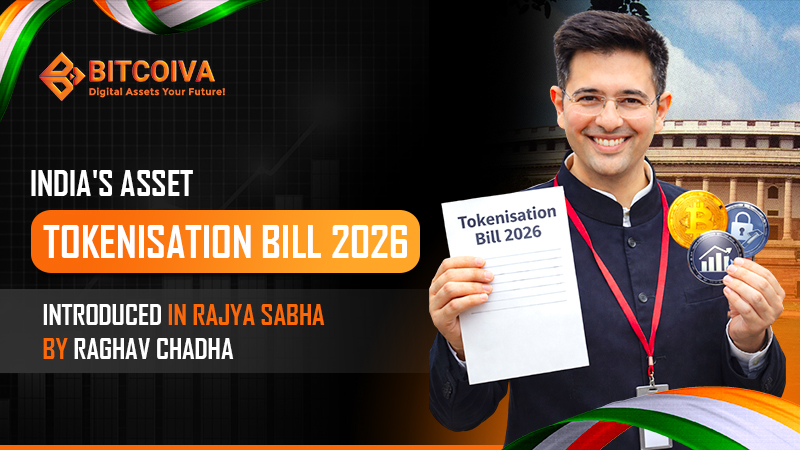
In a notable development in India’s Parliament, Rajya Sabha MP Raghav Chadha introduced a Private Member’s Bill titled “The Asset Tokenisation (Regulation) Bill, 2026.” The bill was presented in the House on March 14, 2026, marking an important step toward establishing a structured legal framework for tokenised real-world assets in India.
The proposed legislation aims to bring clarity, regulation, and oversight to the rapidly evolving field of asset tokenisation. This initiative highlights the growing importance of blockchain technology in modern financial systems.
What Is Asset Tokenisation?
Asset tokenisation is the process of converting ownership rights of physical or financial assets into digital tokens using blockchain technology. Each token represents a fractional share of the underlying asset.
These assets may include:
- Real estate properties
- Infrastructure projects
- Commodities
- Investment instruments
- Other high-value assets
Through tokenisation, investors can purchase smaller portions of expensive assets instead of investing large amounts of capital. This approach promotes fractional ownership and broader market participation.
Key Objectives of the Bill
The proposed Asset Tokenisation (Regulation) Bill, 2026 focuses on creating a comprehensive regulatory structure for tokenised assets in India. The main objectives include:
1. Legal Recognition
To provide official recognition for tokenised real-world assets under Indian law.
2. Regulatory Framework
To define clear rules for issuance, trading, settlement, and custody of tokenised assets.
3. Investor Protection
To ensure transparency, accountability, and safeguards for investors participating in tokenised markets.
4. Supervision and Compliance
To establish monitoring mechanisms and penalties for violations, ensuring proper governance.
Why This Development Is Important
The introduction of this bill is significant because asset tokenisation is becoming an important global financial trend. Many countries are exploring regulated frameworks for blockchain-based asset systems.
If implemented, the bill could:
- Increase accessibility to investment opportunities
- Improve liquidity in traditionally illiquid markets
- Reduce transaction costs
- Enhance transparency through blockchain records
- Encourage financial innovation in India
For retail investors, especially the middle class, tokenisation could open access to asset classes that were previously limited to large institutional investors.
Impact on India’s Financial Ecosystem
India has already demonstrated strong digital growth through fintech innovation and digital payment systems. The proposed bill aligns with the country’s broader vision of embracing technology while maintaining regulatory stability.
By introducing a structured framework, India could:
- Strengthen investor confidence
- Promote responsible innovation
- Prevent misuse of digital asset platforms
- Create a regulated environment for token-based investments
This development may also encourage startups and financial institutions to build compliant tokenisation solutions within the country.
Legislative Process Ahead
Since this is a Private Member’s Bill, it will undergo further parliamentary discussion. The next steps may include:
- Debate in the Rajya Sabha
- Committee examination
- Possible amendments
- Voting procedures
Private Member’s Bills often serve as catalysts for policy discussions, even if they do not immediately become law. However, they can influence future government legislation.
Conclusion
The introduction of India’s Asset Tokenisation Bill 2026 in the Rajya Sabha by Raghav Chadha represents a significant step toward structured regulation of blockchain-based asset systems in India.
If passed, the bill could modernize investment frameworks, enhance transparency, and expand access to asset ownership for a wider section of society. It reflects India’s growing engagement with emerging technologies while emphasizing the importance of regulation and investor protection.
This proposal may shape future discussions on digital assets and contribute to the development of a secure and innovative financial ecosystem in India.
Visit us at: www.bitcoiva.com
FAQ Section
FAQ 1: What is the Asset Tokenisation Bill 2026?
It is a Private Member’s Bill introduced in the Rajya Sabha to regulate tokenised real-world assets in India.
FAQ 2: Who introduced the bill?
Rajya Sabha MP Raghav Chadha introduced the bill.
FAQ 3: What is asset tokenisation?
It is the process of converting ownership rights of physical assets into digital tokens using blockchain technology.
FAQ 4: Why is this bill important?
It aims to create a legal framework, improve transparency, and protect investors in tokenised markets.
FAQ 5: Is the bill passed?
No, it has been introduced and will go through the parliamentary process.