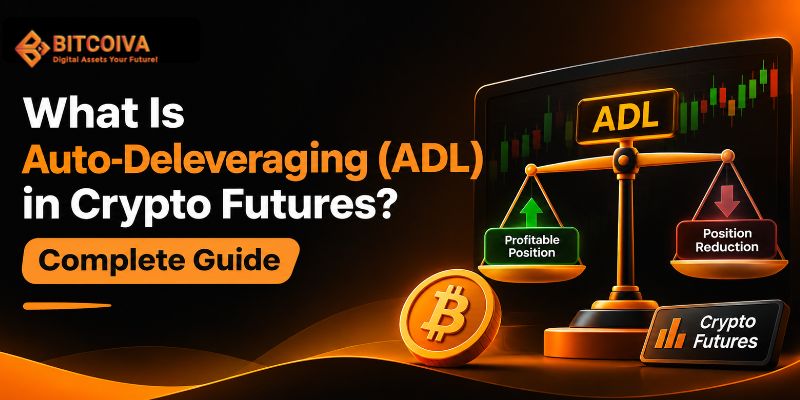
Auto-Deleveraging (ADL) in crypto futures is an important risk management mechanism that protects cryptocurrency derivatives exchanges during extreme market volatility. Understanding how ADL works, its relationship with crypto futures liquidation, and how traders can manage ADL risk is essential for anyone exploring leveraged crypto trading.
What Is Auto-Deleveraging (ADL) in Crypto Futures?
Auto-Deleveraging (ADL) in crypto futures is a mechanism that automatically reduces or closes selected opposing trading positions when an exchange cannot adequately cover losses from liquidated positions.
Unlike regular liquidation, ADL can affect traders who hold profitable crypto futures positions.
When cryptocurrency prices move sharply, highly leveraged positions may generate losses exceeding the available collateral. Crypto exchanges generally use liquidation engines and insurance funds to manage these losses.
If normal risk management mechanisms cannot cover the shortfall, the exchange may activate Auto-Deleveraging as a last-resort measure.
Why Does Auto-Deleveraging Happen in Crypto Trading?
Crypto futures trading allows traders to control larger market positions using relatively small amounts of margin.
While leverage increases market exposure, it also increases liquidation risk.
ADL may become necessary when:
- Highly leveraged crypto positions are liquidated.
- Extreme Bitcoin or altcoin price movements create substantial losses.
- Limited market liquidity prevents orderly liquidation.
- Available insurance resources cannot adequately cover liquidation shortfalls.
The ADL mechanism helps cryptocurrency exchanges manage exceptional liquidation losses and limit further financial instability.
How Does Auto-Deleveraging Work in Crypto Futures?
The crypto futures ADL process generally follows five stages.
Step 1: Position Liquidation
A trader’s leveraged futures position reaches its liquidation threshold because available margin is insufficient.
Step 2: Liquidation Shortfall
During extreme volatility, the liquidation engine may be unable to close the position before losses exceed the trader’s collateral.
Step 3: Insurance Fund Protection
The exchange attempts to cover the remaining losses through applicable insurance resources.
Step 4: ADL Ranking
If the exchange’s ADL conditions are met, eligible opposing positions are ranked based on factors such as profitability and effective leverage.
Step 5: Automatic Position Reduction
Selected opposing positions are partially or fully closed according to the exchange’s ADL settlement rules.
The precise process varies depending on the crypto futures exchange.
Example of Auto-Deleveraging in Bitcoin Futures
Consider two traders participating in Bitcoin futures trading.
Trader A: Opens a BTC long position at $100,000 using 20x leverage.
Trader B: Opens a BTC short position at $100,000.
Suppose Bitcoin’s price falls sharply to $94,000.
Trader A’s leveraged long position would ordinarily reach its liquidation threshold before the entire decline.
If the liquidation process creates a shortfall that available insurance resources cannot cover, the exchange may activate ADL.
Trader B’s profitable short position could be selected for automatic reduction if it ranks sufficiently high in the ADL queue.
Trader B may realize a profit but lose the opportunity to benefit from further price declines.
This example shows why ADL risk management matters even for profitable cryptocurrency futures traders.
What Is an ADL Indicator in Crypto Futures?
An ADL indicator shows a futures position’s relative priority for Auto-Deleveraging.
Many cryptocurrency derivatives exchanges use a five-level ADL ranking system.
| ADL Level | Risk Priority |
|---|---|
| Level 1 | Lower priority |
| Level 2 | Relatively low priority |
| Level 3 | Moderate priority |
| Level 4 | High priority |
| Level 5 | Highest priority |
A higher ADL indicator generally means the position is closer to the front of the ADL queue.
However, a high ranking does not guarantee automatic position closure.
Factors such as unrealized profit and effective leverage commonly influence ADL rankings.
Auto-Deleveraging vs Liquidation in Crypto Futures
Although Auto-Deleveraging and crypto futures liquidation both involve automatic position closures, their purposes differ.
| Feature | Liquidation | Auto-Deleveraging |
|---|---|---|
| Trigger | Insufficient trading margin | Exceptional liquidation risk |
| Affected trader | Trader breaching margin requirements | Selected opposing trader |
| Profitability | Usually losing position | Often profitable position |
| Primary purpose | Manage individual margin risk | Manage exchange-level risk |
| Automatic closure | Yes | Yes |
Key difference: Liquidation occurs because a position fails to meet margin requirements, whereas ADL may affect another trader’s position to manage an exchange-level liquidation shortfall.
Crypto Futures Liquidation Statistics in 2026
According to a CoinGlass Bitcoin liquidation snapshot dated November 16, 2026, approximately $94.34 million in Bitcoin positions were liquidated across tracked exchanges.
The reported figures included:
- Long liquidations: approximately $37.48 million.
- Short liquidations: approximately $56.87 million.
- Liquidated traders: 8,661.
These statistics illustrate the scale of leveraged cryptocurrency trading activity.
However, crypto futures liquidations and ADL events are not the same. High liquidation volume does not necessarily indicate that Auto-Deleveraging occurred.
How Can Traders Reduce ADL Risk in Crypto Futures?
Although Auto-Deleveraging cannot always be avoided, traders can manage their exposure through several practices.
1. Use Appropriate Leverage
Lower effective leverage may reduce ADL priority on exchanges using leverage-based ranking systems.
2. Monitor ADL Indicators
Check available ADL warning indicators to understand your position’s relative ranking.
3. Manage Trading Positions
Reducing position size can limit the amount of exposure potentially affected by ADL.
4. Monitor Market Volatility
Sudden cryptocurrency price movements and limited liquidity can increase liquidation activity.
5. Understand Exchange Risk Policies
Review the exchange’s insurance fund, margin requirements, liquidation procedures, and ADL settlement rules before trading.
These measures may help manage risk but cannot guarantee protection from ADL.
Explore Crypto Futures Trading with Bitcoiva
Looking for the best crypto futures trading platform in India? Bitcoiva is a cryptocurrency trading platform offering access to digital asset markets and crypto futures trading features.
Explore crypto futures trading with Bitcoiva and learn about leverage, market movements, and trading risk management.
Visit Bitcoiva to discover available trading tools and cryptocurrency market opportunities.
Conclusion
Auto-Deleveraging (ADL) in crypto futures is an important risk management mechanism that helps exchanges handle exceptional liquidation losses.
Understanding the ADL mechanism, crypto futures liquidation, leverage, and ADL ranking indicators can help traders make more informed decisions when participating in cryptocurrency derivatives markets.
Frequently Asked Questions About ADL in Crypto Futures
1. What does ADL mean in crypto futures trading?
ADL stands for Auto-Deleveraging. It is a mechanism used by crypto futures exchanges to reduce selected opposing positions during exceptional liquidation events.
2. Can Auto-Deleveraging affect profitable traders?
Yes. Profitable crypto futures traders may experience automatic position reductions based on their ADL rankings.
3. What triggers Auto-Deleveraging in cryptocurrency trading?
ADL may occur when exceptional liquidation losses cannot be adequately handled through an exchange’s normal liquidation and insurance arrangements.
4. How can traders reduce ADL risk?
Using appropriate leverage, monitoring ADL indicators, and managing position exposure may help reduce ADL-related risk.
5. Is ADL the same as liquidation in crypto futures?
No. Liquidation results from insufficient margin, while Auto-Deleveraging manages exceptional exchange-level liquidation risk.
Risk Disclaimer: Crypto futures trading involves substantial financial risk. Leverage can amplify losses, and positions may be liquidated or automatically reduced. This article is for educational purposes and does not constitute investment advice.