
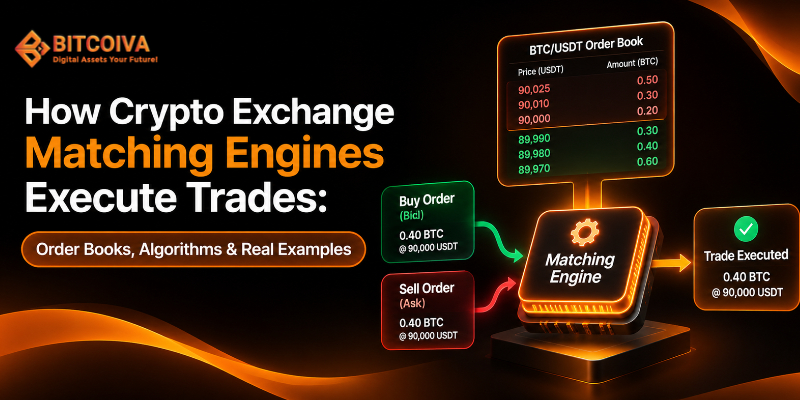
Have you ever wondered what happens after you click the Buy or Sell button on a cryptocurrency exchange?
Your order does not automatically become a completed trade. Instead, it passes through a crypto exchange matching engine, the technology responsible for connecting compatible buyers and sellers.
These systems play an essential role in determining trade execution, order priority, and market liquidity.
Let’s understand how cryptocurrency matching engines work, supported by practical examples and recent market statistics.
What Is a Crypto Exchange Matching Engine?
A crypto exchange matching engine is a software system that processes buy and sell orders according to predefined matching rules.
It identifies compatible orders within a trading pair, such as BTC/USDT, and executes trades when their prices and quantities meet the necessary conditions.
For example, if one trader wants to buy Bitcoin at 90,000 USDT and another is willing to sell at that price, their orders may match.
If no compatible sell order exists, a standard limit buy order can remain in the order book until it is executed or cancelled.
How Does a Crypto Matching Engine Execute Trades?
A centralized cryptocurrency exchange typically follows five stages.
- Order submission: A trader submits a market order or limit order.
- Order validation: The platform checks account balances, order limits, and trading requirements.
- Order matching: The engine compares the incoming order with compatible orders already available.
- Trade execution: Matching quantities are executed at prices determined by the exchange’s trading rules.
- Account updates: Trade records and internal account balances are updated.
This automated process allows buyers and sellers to trade without negotiating directly with each other.
How Does an Order Book Work in Cryptocurrency Trading?
An order book contains outstanding buy orders, called bids, and sell orders, called asks.
Buyers generally prefer lower prices, while sellers prefer higher prices.
Consider this hypothetical BTC/USDT sell order book:
| Selling Price | Available BTC |
|---|---|
| 90,000 USDT | 0.20 BTC |
| 90,010 USDT | 0.30 BTC |
| 90,025 USDT | 0.50 BTC |
Suppose a trader submits a market order to purchase 0.40 BTC.
The matching engine executes:
- 0.20 BTC × 90,000 = 18,000 USDT
- 0.20 BTC × 90,010 = 18,002 USDT
Total execution value: 36,002 USDT
Average execution price: 90,005 USDT per BTC
The order is completed across two price levels because the best available selling price did not contain sufficient quantity.
This example demonstrates how market depth affects execution. All prices are illustrative, not live market quotations.
What Is Price-Time Priority in Crypto Order Matching?
Price-time priority is a matching method that prioritizes the best available price, followed by the earliest eligible order at that price.
For example:
- Trader A places a sell order at 90,000 USDT at 10:00:01.
- Trader B places another sell order at 90,000 USDT at 10:00:05.
Under a standard First-In, First-Out (FIFO) matching system, Trader A’s order receives priority.
CME Group’s technical documentation describes FIFO as a matching method that considers price and time when determining execution priority.
However, not every trading market uses identical allocation rules.
What Is the Difference Between Market Orders and Limit Orders?
A market order attempts to execute immediately against available orders. Its final execution price depends on market liquidity.
A limit order specifies the maximum acceptable buying price or minimum acceptable selling price.
For example, a limit buy order at 90,000 USDT cannot execute above 90,000 USDT under standard limit-order rules.
Market orders prioritize immediate execution, while limit orders provide price restrictions but do not guarantee execution.
How Much Trading Activity Do Crypto Matching Engines Handle?
Recent research highlights the scale of centralized cryptocurrency trading.
According to CoinDesk Research’s October 2026 Exchange Review, published on November 11, 2026:
- $1.02 trillion in centralized spot trading volume was recorded during October.
- $3.87 trillion in centralized derivatives trading volume was recorded.
- 79.1% of combined centralized trading volume came from derivatives.
- Spot trading volume declined 9.7% compared with September.
These figures indicate the substantial trading activity supported by centralized exchange infrastructure.
However, trading volume does not directly measure matching-engine speed, execution latency, or reliability.
How Do Matching Engines Affect Liquidity and Slippage?
Liquidity refers to the availability of assets for trading without causing substantial price changes.
Slippage occurs when the actual average execution price differs from the expected price.
Kaiko’s cryptocurrency liquidity research explains that order-book depth and trading volume provide different information about market liquidity.
Depth shows available orders at a particular moment, while trading volume measures completed activity over time.
Even a technically efficient matching engine cannot eliminate slippage when liquidity is limited or market prices change rapidly.
Are Crypto Matching Engines the Same as Blockchain Transactions?
No. Centralized exchanges generally execute trades using internal order-matching systems rather than recording every trade directly on a blockchain.
Blockchain transactions are commonly required when cryptocurrency enters or leaves an exchange through deposits or withdrawals.
Decentralized trading platforms may use different mechanisms, including automated market makers and smart contracts.
Conclusion
Crypto exchange matching engines are fundamental to cryptocurrency trading infrastructure.
They process orders, apply matching rules, and execute compatible trades based on available liquidity.
Understanding price-time priority, market depth, order types, and slippage helps traders interpret how cryptocurrency transactions are executed.
Explore more cryptocurrency trading concepts and educational resources with Bitcoiva to improve your understanding of digital asset markets.
Visit: www.bitcoiva.com
Frequently Asked Questions
1. How does a crypto exchange matching engine work?
It compares buy and sell orders and executes compatible trades according to the exchange’s matching rules.
2. What is the main purpose of a matching engine?
Its main purpose is to process eligible trading orders and determine how they are matched and executed.
3. Can a cryptocurrency order be partially executed?
Yes. If sufficient liquidity is unavailable at compatible prices, an order may be partially filled, depending on its type and execution instructions.
4. What causes slippage during crypto trade execution?
Slippage can result from insufficient liquidity, changing market prices, or large orders consuming multiple price levels.
5. Do all crypto exchanges use the same matching algorithm?
No. Different trading venues may use FIFO, pro-rata, or other matching and allocation methodologies.
Disclaimer: This article is for educational purposes only and does not constitute financial or investment advice. Market statistics reflect reported historical trading activity, and the BTC/USDT examples are hypothetical.