

Bitcoin has a feature that separates it from traditional currencies: its supply is limited by protocol rules.
Under Bitcoin’s current rules, total issuance approaches 21 million BTC. Unlike fiat currencies, there is no central bank deciding how many new bitcoins should be issued each year. Instead, Bitcoin follows a predetermined issuance schedule.
By September 2026, approximately 20.09 million BTC had already been issued—more than 95% of the maximum supply.
But this does not mean the remaining Bitcoin will be mined within the next few years.
Bitcoin’s block subsidy is cut in half every 210,000 blocks. Because issuance becomes progressively smaller, the final fractions of new Bitcoin are expected to be issued around 2140 under the current protocol rules.
So what happens after that?
Will miners disappear? Will Bitcoin transactions stop? Who will secure the blockchain when there are no new bitcoins to reward miners?
To answer those questions, we first need to understand how Bitcoin’s supply system works.
1. Why Does Bitcoin Have a Limited Supply?
Bitcoin was launched in January 2009 by its pseudonymous creator, Satoshi Nakamoto.
New bitcoins are introduced through mining.
Miners use specialized computing hardware to perform proof-of-work, help confirm transactions and compete to add new blocks to the Bitcoin blockchain.
When a miner successfully produces a valid block, the block’s revenue consists primarily of two components:
Miner Revenue = Block Subsidy + Transaction Fees
The block subsidy is newly issued BTC.
Transaction fees are paid by users whose transactions are included in the block.
Bitcoin began with a block subsidy of:
50 BTC per block
But that reward does not remain constant.
Every 210,000 blocks, roughly once every four years, the subsidy is cut in half.
This event is known as the Bitcoin halving.
2. Bitcoin Halving Explained
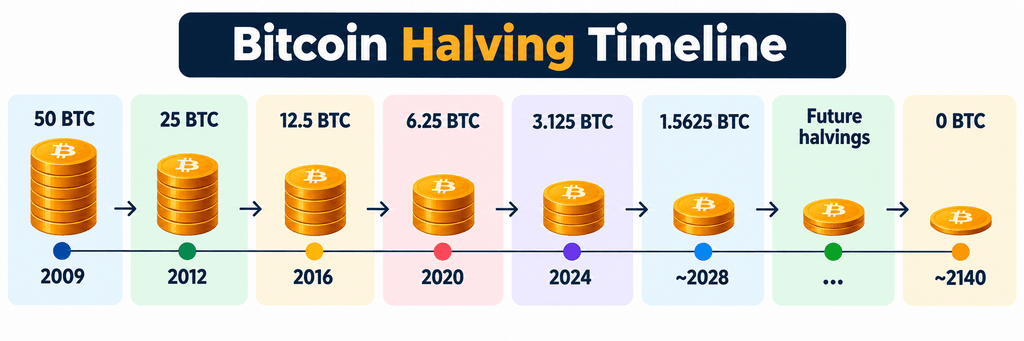
Bitcoin’s halving mechanism gradually reduces the amount of new BTC entering circulation.
| Halving period | Block subsidy |
|---|---|
| 2009–2012 | 50 BTC |
| 2012–2016 | 25 BTC |
| 2016–2020 | 12.5 BTC |
| 2020–2024 | 6.25 BTC |
| 2024–~2028 | 3.125 BTC |
| ~2028–2032 | 1.5625 BTC |
| ~2032–2036 | 0.78125 BTC |
Bitcoin’s fourth halving occurred at block 840,000 in April 2024, reducing the block subsidy from 6.25 BTC to 3.125 BTC.
The next halving is expected around 2028, at block 1,050,000. It will reduce the subsidy to:
1.5625 BTC per block
The exact calendar date cannot be known far in advance because halvings are determined by block height rather than a fixed calendar date.
3. How Much Bitcoin Has Already Been Issued?
As of September 2026, Bitcoin has passed the 20 million BTC milestone.
Around 20.08–20.09 million BTC were in circulation by September 2026, representing approximately 95.6% of Bitcoin’s maximum supply.
Bitcoin Supply Snapshot — September 2026
| Metric | Approximate figure |
|---|---|
| Maximum supply | ~21 million BTC |
| Issued/circulating supply | ~20.09 million BTC |
| Percentage issued | ~95.6% |
| Remaining theoretical issuance | ~0.91 million BTC |
| Current block subsidy | 3.125 BTC |
| Next subsidy | 1.5625 BTC |
| Final issuance | Around 2140 |
The figures change slightly with every newly mined block, so supply should always be treated as a time-stamped figure rather than a permanent number.
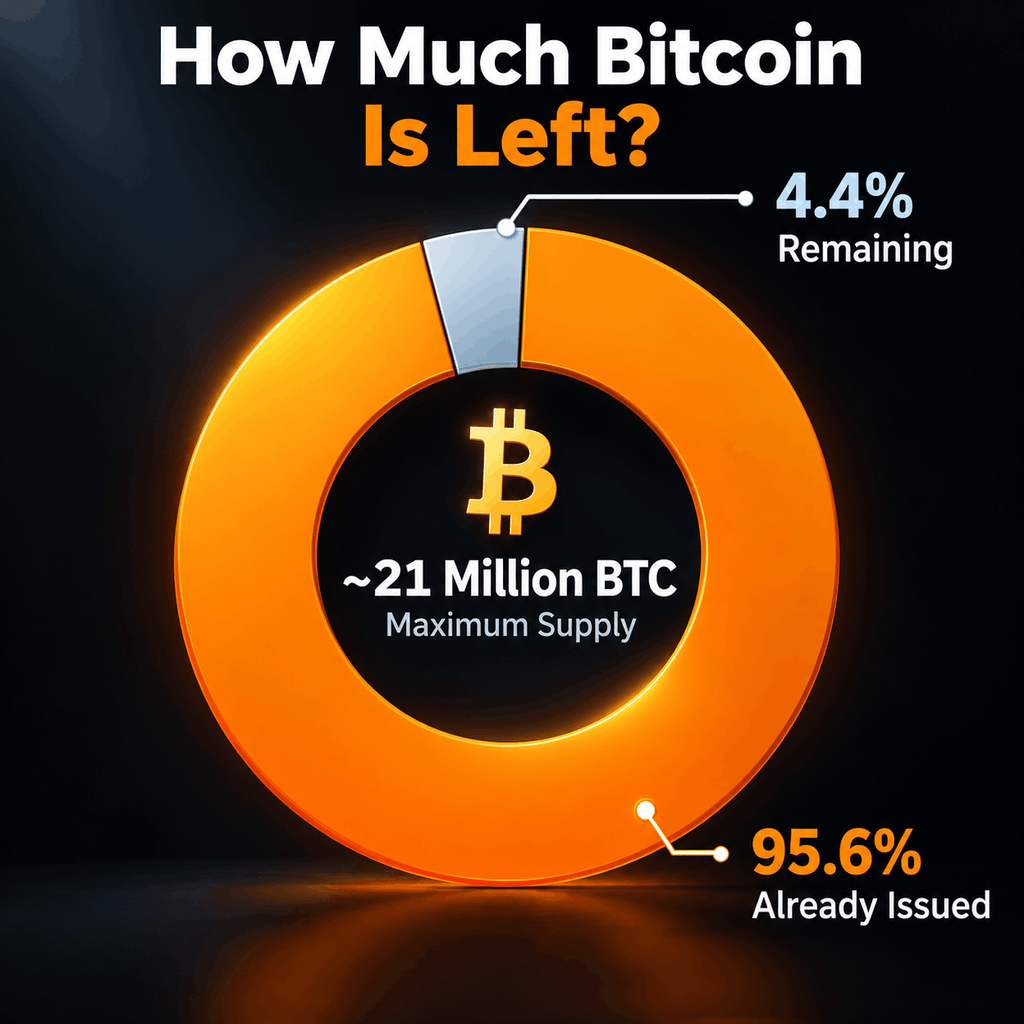
Data snapshot: September 2026. Supply increases slightly with each block until issuance eventually ends.
4. Why Does the Remaining Bitcoin Take Until 2140?
This is where Bitcoin’s mathematics becomes interesting.
If more than 95% of Bitcoin has already been issued, why does the remaining portion take more than 100 years?
The answer is halving.
Imagine Bitcoin issuance as a tap that releases fewer coins every four years.
Initially:
50 BTC/block
Then:
25 BTC/block
Then:
12.5 BTC/block
Then:
6.25 BTC/block
Today:
3.125 BTC/block
Next:
1.5625 BTC/block
Then:
0.78125 BTC/block
And the sequence continues.
Each halving reduces new issuance by 50%.
Bitcoin can also be divided into very small units.
1 BTC = 100,000,000 satoshis
1 satoshi = 0.00000001 BTC
Eventually, the calculated block subsidy becomes too small to represent even one satoshi and effectively reaches zero.
Under the present protocol rules, that point is expected around 2140.
5. What Happens When All Bitcoin Is Mined?
Here is the most important misconception to clear up:
Bitcoin mining does NOT simply stop when new Bitcoin issuance ends.
What stops is the block subsidy—the creation of new BTC as part of the miner’s block reward.
Bitcoin.org explicitly notes that mining will still be required after the final Bitcoin is issued.
Miners will still perform important functions such as processing transactions, producing blocks and providing proof-of-work that helps secure the network.
What changes is how they are compensated.
Today:
Miner Revenue = Block Subsidy + Transaction Fees
Eventually:
Miner Revenue = Transaction Fees
In other words, Bitcoin is designed to transition gradually from a system heavily supported by new BTC issuance toward one supported by transaction fees.
6. How Are Bitcoin Miners Paid Today?
Consider an actual Bitcoin block.
Bitcoin block 967,641, mined on September 19, 2026, contained 6,937 transactions.
Blockchain.com’s block explorer recorded:
Block subsidy: approximately 3.125 BTC
Transaction fees: approximately 0.00432549 BTC
Total block reward: approximately 3.12932549 BTC.
This is a useful real-world example.
For this particular block, the newly issued subsidy was much larger than the transaction-fee component.
However, fees vary significantly from block to block depending on transaction demand and users’ willingness to pay for block space.
Therefore, one block should not be interpreted as the average for the entire Bitcoin network.
7. What Happens to Miners After 2140?
Once the block subsidy reaches zero, miners will no longer receive newly created BTC.
Their direct block revenue would instead come from:
Transaction fees
Suppose users submit thousands of transactions to the Bitcoin network.
Each transaction can include a fee.
When demand for Bitcoin’s limited block space is high, users may compete by offering higher fee rates for faster inclusion.
Miners have an economic incentive to include transactions offering attractive fees.
This creates what is commonly called a:
Fee Market
Conceptually:
Users send transactions
↓
Transactions compete for block space
↓
Users offer fees
↓
Miners select transactions
↓
Block is produced
↓
Miner receives transaction fees
As the subsidy continues to fall, transaction fees are expected to become increasingly important to miner revenue. Bitcoin.org describes fees as the long-term incentive expected to replace new-coin issuance.
8. Will Bitcoin Mining Still Be Profitable?
This cannot be answered with certainty today.
2140 is more than a century away, and the economics of mining could be radically different.
Mining profitability will depend on factors such as:
Transaction fees: Higher demand for block space can increase miner fee revenue.
Bitcoin’s market price: The fiat value of BTC-denominated revenue depends on BTC’s market price.
Electricity costs: Energy is a major operating cost for proof-of-work mining.
Mining hardware: More efficient hardware can reduce the energy required per unit of computing power.
Mining difficulty: Bitcoin automatically adjusts mining difficulty in response to changes in total network computing power.
Network hashrate: Competition among miners affects how much computing power is required to win blocks consistently.
The correct question therefore isn’t:
“Will mining still make money in 2140?”
No one can reliably answer that today.
A better question is:
Will transaction fees provide enough economic incentive to support the level of mining activity needed by the future Bitcoin network?
That remains an important long-term economic question.
9. Bitcoin’s Long-Term Security Budget
Bitcoin uses proof-of-work to secure its blockchain.
Miners expend computational resources to find valid blocks.
Their economic incentive comes from the revenue they earn for doing so.
That creates what researchers often discuss as Bitcoin’s security budget.
Currently, that security budget is supported by:
Block Subsidy + Transaction Fees
But over time:
Block subsidy ↓
while the importance of:
Transaction fees ↑
After new issuance ends:
Transaction Fees → Miner Revenue
The long-term question is whether the fee market will be sufficiently strong to support the desired level of network security.
It is important not to claim that Bitcoin will definitely face a security crisis—or that transaction fees will definitely solve everything.
Both statements would require assumptions about a future more than 100 years away.
10. What If Some Miners Stop Mining?
Bitcoin includes an important mechanism known as difficulty adjustment.
The network targets an average block interval of approximately:
10 minutes
Mining difficulty adjusts every 2,016 blocks, roughly every two weeks under the target schedule.
If substantial computing power leaves the network, difficulty can eventually adjust downward.
If substantial computing power joins the network, difficulty can adjust upward.
This mechanism helps Bitcoin continue producing blocks despite changes in mining participation.
However, there is an important distinction:
Difficulty adjustment helps maintain block production.
It does not automatically guarantee a particular level of economic security.
That depends on how much computing power and economic cost protect the network.
11. Will Bitcoin Transactions Stop After 2140?
No.
The end of new Bitcoin issuance does not mean the blockchain automatically shuts down.
Bitcoin transactions can continue.
The basic process remains:
User sends BTC
↓
Transaction enters the network
↓
Miner includes transaction in a block
↓
Proof-of-work secures the block
↓
Block becomes part of the blockchain
↓
Miner receives transaction fees
Bitcoin.org specifically states that mining will still be required after the last Bitcoin has been issued.
12. Does Bitcoin Become More Scarce After 2140?
Bitcoin’s issuance would effectively stop.
That means:
New BTC created through block subsidies = 0
However, this needs careful interpretation.
Bitcoin does not suddenly become scarce only in 2140.
Its issuance is becoming scarcer with every halving.
The annual rate of new supply progressively declines until it eventually reaches zero.
Also, fixed supply does not automatically mean a higher price.
Bitcoin.org notes that Bitcoin’s price ultimately depends on supply and demand.
If demand rises while available supply remains limited, that can put upward pressure on price.
If demand falls, price can decline.
Therefore:
Fixed supply ≠ Guaranteed price increase
13. Are All 21 Million Bitcoins Actually Available?
No.
There is an important difference between:
Bitcoin issued
and
Bitcoin available to spend
Bitcoin can become inaccessible when users lose their private keys, destroy wallet backups or otherwise permanently lose access to their coins.
However, the exact amount of permanently lost Bitcoin cannot be known with certainty.
A blockchain can show that BTC has not moved, but it generally cannot prove why it has not moved.
For example, an old wallet might represent:
- lost private keys,
- a long-term holder,
- an inaccessible wallet,
- dormant funds,
- or coins intentionally left untouched.
For this reason, claims such as “exactly X million Bitcoin are permanently lost” should be treated as estimates, not verified facts.
14. Bitcoin Price: From Less Than a Cent to 2026
Bitcoin’s price history provides useful context for how dramatically the network has developed.
But historical performance does not tell us what Bitcoin will be worth in 2140.
Bitcoin initially had no established market price.
One early recorded exchange in 2009 valued Bitcoin at approximately:
$0.00099 per BTC
Forbes reports that 5,050 BTC were exchanged for $5.02 through PayPal, producing an implied value of less than one-tenth of a cent per BTC.
By 2010, Bitcoin had begun trading at fractions of a dollar. In early 2011, it crossed $1 for the first time.
The market expanded dramatically afterward.
Selected Bitcoin Price Milestones
| Period | Historical milestone |
|---|---|
| 2009 | ~$0.00099 implied early exchange value |
| 2010 | Reached cent-level trading |
| Early 2011 | Crossed $1 |
| Jan. 2013 | ~$13.30 |
| Dec. 2013 | Reached above $1,100 |
| 2017 | Approached $20,000 |
| 2021 | Reached above $60,000 |
| Mar. 2024 | Reached above $70,000 |
| Oct. 2025 | Reached roughly $126,000 intraday |
| Sep. 2026 | Around the high-$70,000s to low-$80,000s during the current period |
Forbes reports a 52-week intraday high of approximately $126,198 on October 6, 2025 and quoted BTC around $77,717 in its September 2026 update.
Because Bitcoin trades continuously, a live price should always include a timestamp rather than being presented as a permanent figure.
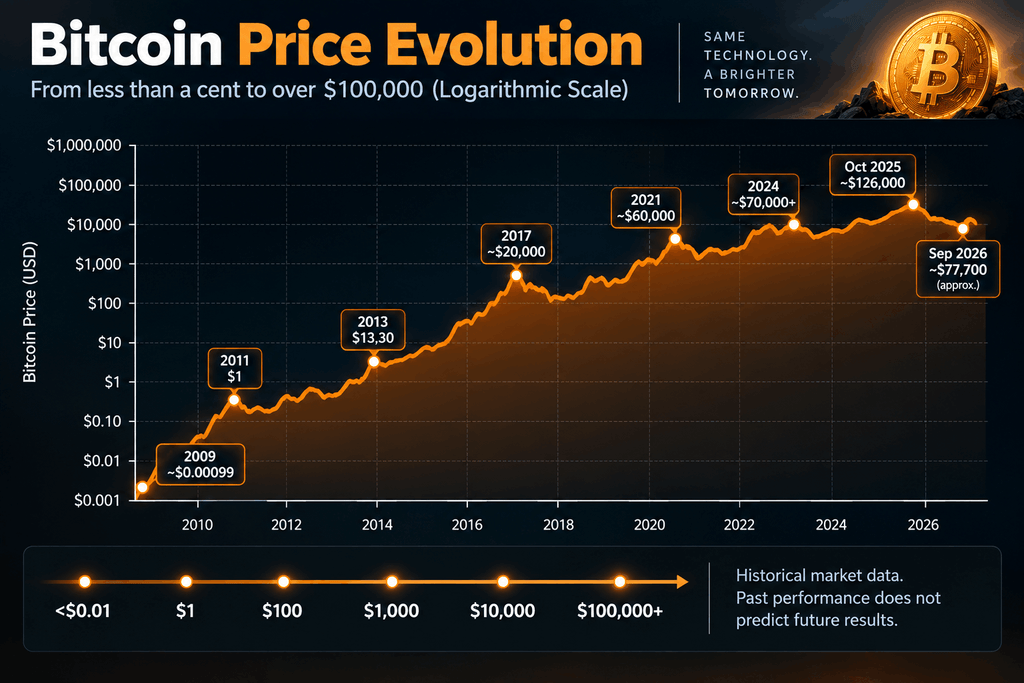
Historical market data. Past performance does not predict future results.
15. Does Bitcoin Halving Automatically Increase the Price?
No.
This is another common misconception.
The halving has a mathematically predictable effect on one thing:
New Bitcoin issuance
For example:
Before the 2024 halving:
6.25 BTC/block
After the 2024 halving:
3.125 BTC/block
Expected after the next halving:
1.5625 BTC/block
But Bitcoin’s market price is influenced by many factors, including demand, liquidity, macroeconomic conditions, regulation, market sentiment and investor behaviour.
Therefore:
Halving = Predictable reduction in new supply
Price reaction = Not predictable with certainty
Historical post-halving price movements should not be presented as proof that future halvings will produce the same result.
16. What Role Could the Lightning Network Play?
Bitcoin’s base blockchain has limited block space.
Not every small payment necessarily has to be individually settled on-chain.
The Lightning Network is a Layer-2 payment system that allows participants to conduct payments through payment channels while ultimately relying on Bitcoin for settlement.
This creates an interesting long-term economic relationship.
Bitcoin wants efficient scaling.
At the same time, miners increasingly depend on demand for base-layer block space as subsidies decline.
Future Bitcoin economics could therefore involve interaction between:
Bitcoin base layer
Lightning and other scaling systems
Settlement demand
Transaction fees
Miner incentives
Exactly how these factors develop over the next century cannot be known today.
17. Could Bitcoin’s 21 Million Limit Be Changed?
Bitcoin is software, so developers can technically propose different rules.
But a developer cannot simply press a button and force every Bitcoin participant to accept additional supply.
Bitcoin nodes independently enforce the consensus rules they accept.
Bitcoin.org explains that nodes reject blocks that violate the rules they expect the network to follow.
Therefore, increasing Bitcoin’s supply limit would require participants to adopt incompatible monetary rules.
That makes the issue both:
Technical
and
Social/economic
The accurate statement is therefore:
Bitcoin’s supply limit exists under its current consensus rules. Changing those rules is technically conceivable, but it cannot simply be imposed unilaterally on nodes continuing to enforce the existing rules.
18. Bitcoin’s Transition Has Already Started
It is easy to think of 2140 as the moment Bitcoin’s economic system suddenly changes.
That is misleading.
The transition is already happening.
Bitcoin’s Miner-Revenue Evolution
2009
Large block subsidy
- transaction fees
↓
2024
3.125 BTC subsidy
- transaction fees
↓
~2028
1.5625 BTC subsidy
- transaction fees
↓
Future decades
Progressively smaller subsidy
- transaction fees
↓
~2140
0 BTC subsidy
- transaction fees
Bitcoin therefore has more than a century to move gradually from subsidy-supported mining toward a fee-supported model.
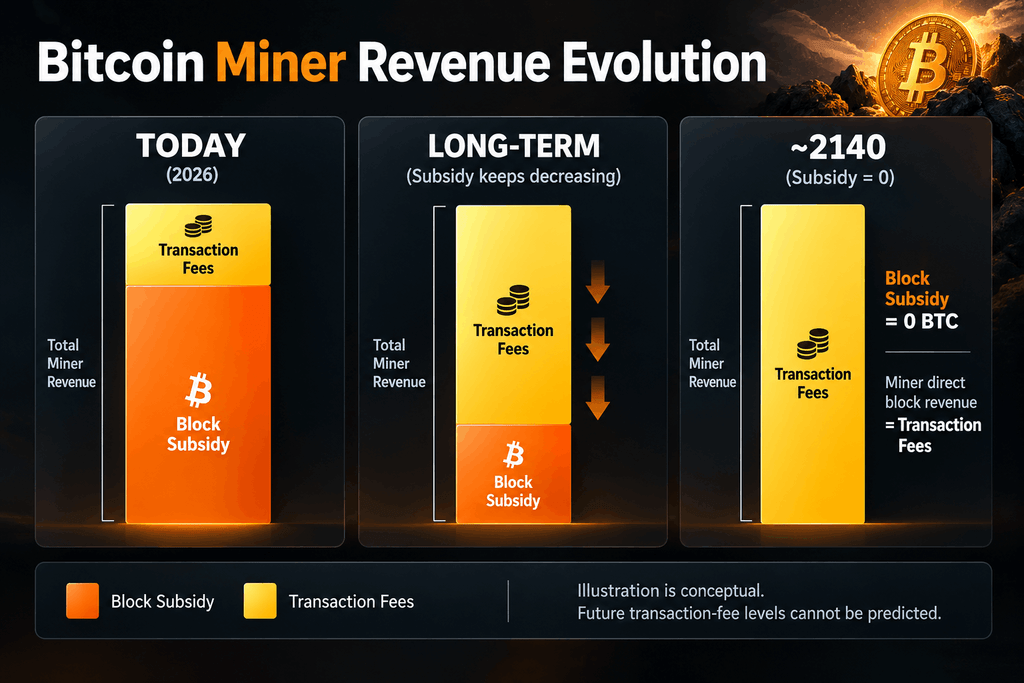
Illustration is conceptual. Future transaction-fee levels cannot be predicted.
19. The Real Question Isn’t “What Happens in 2140?”
There is a deeper way to understand this topic.
Bitcoin’s monetary system can be divided into three broad phases.
Phase 1 — High-Issuance Bitcoin
Early Bitcoin had large block subsidies.
50 BTC → 25 BTC → 12.5 BTC
Phase 2 — Declining-Issuance Bitcoin
Bitcoin is currently in this phase.
6.25 BTC → 3.125 BTC → 1.5625 BTC → progressively smaller rewards.
Phase 3 — Fee-Supported Bitcoin
Eventually:
Block subsidy ≈ 0
Miners depend primarily—and ultimately entirely at the protocol block-reward level—on transaction fees.
This creates one of Bitcoin’s most important long-term economic questions:
Can Bitcoin develop a sufficiently valuable fee market to maintain strong mining incentives after block subsidies disappear?
We do not yet know the answer.
And that uncertainty is more informative than pretending that Bitcoin’s economics in 2140 can already be predicted.
Conclusion
So, what happens when all Bitcoin is mined?
Bitcoin does not automatically shut down.
Transactions do not automatically stop.
And miners do not automatically disappear.
Instead, the most significant change is economic:
New Bitcoin issuance ends.
Under Bitcoin’s current protocol rules, the block subsidy continues halving until it eventually reaches zero around 2140. Miners can continue producing blocks, but transaction fees would become their direct block revenue.
By September 2026, approximately 20.09 million BTC—more than 95% of the maximum supply—had already been issued. Yet because issuance repeatedly halves, the remaining portion will take more than a century to distribute.
The biggest long-term question is therefore not whether Bitcoin suddenly “runs out.”
It is whether Bitcoin’s fee market, user demand, mining economics and technological ecosystem can successfully support the network as block subsidies become progressively smaller.
That transition is not waiting until 2140.
It is already underway.
Frequently Asked Questions
1. How many Bitcoins will ever exist?
Under Bitcoin’s current consensus rules, total issuance approaches approximately 21 million BTC.
2. How much Bitcoin has already been mined?
By September 2026, approximately 20.09 million BTC, or more than 95% of the maximum supply, had already been issued. The figure increases slightly with each new block.
3. When will all Bitcoin be mined?
Under the current issuance schedule, the block subsidy is expected to reach zero around 2140.
4. What is the current Bitcoin block subsidy?
As of September 2026, it is 3.125 BTC per block, plus transaction fees.
5. When is the next Bitcoin halving?
The next halving is expected around 2028 at block 1,050,000, reducing the subsidy from 3.125 BTC to 1.5625 BTC. The exact date depends on block production.
6. Will Bitcoin mining stop after 2140?
No. Mining will still be required to produce blocks and secure transactions. What ends is the issuance of new BTC through the block subsidy.
7. How will miners make money after all Bitcoin is issued?
Under the current design, miners would receive transaction fees rather than newly issued BTC.
8. Will Bitcoin transactions stop after 2140?
No. Bitcoin transactions can continue as long as the network continues operating and miners continue producing blocks.
9. Will Bitcoin’s price increase when all Bitcoin is mined?
There is no guaranteed outcome. Bitcoin’s market price depends on supply and demand and numerous market factors. Fixed supply alone does not guarantee price appreciation.
10. What is a Bitcoin halving?
A halving is the programmed 50% reduction in Bitcoin’s block subsidy every 210,000 blocks, approximately every four years.
11. How many satoshis are in one Bitcoin?
1 BTC = 100,000,000 satoshis.
12. Are all mined Bitcoins still accessible?
No. Some Bitcoin is believed to be permanently inaccessible because private keys have been lost. However, the exact amount cannot be verified with certainty.
13. Can Bitcoin’s 21 million supply limit be changed?
Different software rules can technically be proposed, but nodes independently enforce the rules they accept. A change cannot simply be imposed on nodes continuing to enforce Bitcoin’s existing monetary rules.
14. Does every Bitcoin halving make BTC more valuable?
No. A halving predictably reduces new issuance; it does not guarantee any particular market-price movement.
15. What is Bitcoin’s biggest challenge after block subsidies disappear?
One major long-term economic question is whether transaction fees will provide sufficient incentives for mining and network security once new-coin subsidies disappear.