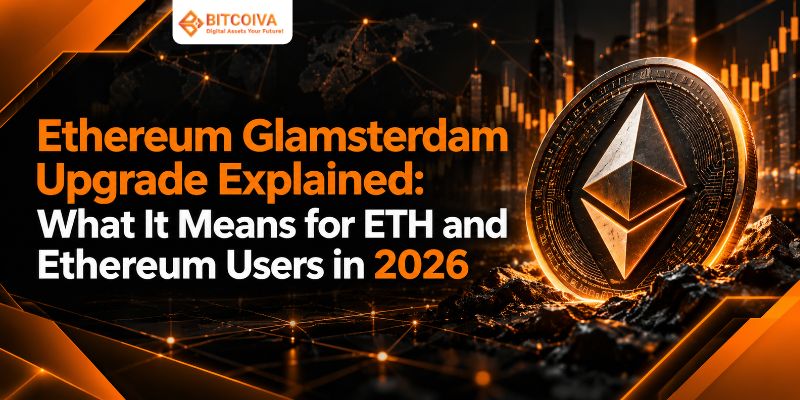
Ethereum continues to evolve as one of the world’s most widely used blockchain networks. From decentralized finance (DeFi) and stablecoins to NFTs and Web3 applications, Ethereum supports a broad digital ecosystem. However, increasing blockchain activity also creates challenges around scalability, transaction processing, and efficient network operation.
The Ethereum Glamsterdam upgrade is designed to address some of these challenges and prepare Ethereum for its next stage of Layer 1 scaling.
Glamsterdam is currently progressing through testnet deployment, with activation on the Sepolia testnet scheduled for October 6, 2026. Ethereum’s mainnet activation date has not yet been confirmed.
What Is the Ethereum Glamsterdam Upgrade?
Glamsterdam is Ethereum’s next major network upgrade following Fusaka. Its name combines Gloas, the consensus-layer upgrade, with Amsterdam, the execution-layer upgrade.
Rather than focusing on a single feature, Glamsterdam introduces several protocol improvements intended to make Ethereum more scalable and efficient.
Two of its most significant changes are Enshrined Proposer-Builder Separation (ePBS) and Block-Level Access Lists (BALs).
Together, these changes modify how Ethereum blocks are built, distributed, and validated, creating a foundation for greater Layer 1 throughput.
Enshrined Proposer-Builder Separation Explained
Ethereum validators propose blocks, while specialized builders can assemble transaction payloads. Glamsterdam introduces EIP-7732, which brings proposer-builder separation directly into Ethereum’s consensus protocol.
Under this model, a proposer can include a builder’s commitment, while the builder subsequently reveals the execution payload. Payments between builders and proposers are also handled at the protocol level.
The goal is to reduce Ethereum’s reliance on external middleware for coordinating this process while improving the efficiency of block production.
For ordinary ETH holders, much of this happens behind the scenes. However, improving Ethereum’s underlying block-building infrastructure can contribute to a more resilient network.
What Are Block-Level Access Lists?
Another major Glamsterdam feature is Block-Level Access Lists (BALs).
Currently, Ethereum must perform significant amounts of transaction processing sequentially. BALs provide information about the accounts and stored blockchain data that transactions within a block are expected to access.
With this information available earlier, Ethereum clients can prepare data more efficiently and potentially process independent operations in parallel.
This is important because parallelization could help Ethereum safely process greater amounts of activity as the network grows.
Can Glamsterdam Increase Ethereum’s Capacity?
Increasing Ethereum’s Layer 1 capacity is one of the major objectives surrounding Glamsterdam.
During testing, developers have been experimenting with a 200 million block gas limit, significantly higher than Sepolia’s previous level of around 60 million.
A higher gas limit means more computational activity can potentially fit inside each block, creating additional room for token transfers, decentralized applications, stablecoin transactions, and other smart-contract activity.
However, the 200 million figure is currently a testnet parameter and should not be interpreted as a confirmed Ethereum mainnet gas limit.
Testing is necessary because larger blocks also require validators and nodes to process more information. Ethereum developers therefore need to determine how much additional capacity can be introduced without making network participation excessively demanding.
Will Glamsterdam Reduce Ethereum Gas Fees?
Glamsterdam should not be viewed as a guarantee of permanently low Ethereum gas fees.
Gas fees depend on several factors, particularly demand for block space. Increasing network capacity could give Ethereum more room to handle activity before users compete heavily for limited block space, potentially helping reduce extreme congestion.
The upgrade also includes changes to gas pricing so that certain operations more accurately reflect the computational and state-related resources they consume.
For users, the broader objective is a network capable of supporting greater activity more efficiently—not a promise that every transaction will suddenly become inexpensive.
What Does Glamsterdam Mean for ETH Holders?
For most ETH holders, the upgrade should require no immediate action during the Sepolia testing phase.
Users should be cautious of messages claiming that they need to transfer ETH, exchange their tokens, or connect a wallet to “upgrade” their ETH.
ETH does not need to be replaced because of Glamsterdam.
The bigger significance for holders is Ethereum’s continued technical development. Greater scalability and more efficient infrastructure could help Ethereum support future growth across DeFi, stablecoins, tokenization, Web3 applications, and other blockchain use cases.
However, a network upgrade does not guarantee that the ETH price will increase. Cryptocurrency prices remain influenced by market sentiment, liquidity, regulation, adoption, macroeconomic conditions, and many other factors.
What Happens Next?
Glamsterdam is scheduled to activate on the Sepolia testnet on October 6, 2026.
Further testing will allow developers, node operators, application teams, and infrastructure providers to evaluate how the new protocol changes perform under more realistic conditions.
The Ethereum Foundation has not yet announced a confirmed Glamsterdam mainnet activation date. Users should therefore follow official Ethereum sources rather than relying on unofficial launch-date claims.
How to Buy Ethereum (ETH) in India?
Indian users interested in Ethereum can purchase ETH through a cryptocurrency exchange that supports INR transactions.
One option is Bitcoiva, a crypto exchange platform serving users in India. Bitcoiva supports INR deposits through payment methods including IMPS, NEFT, and RTGS, while its OTC service lists the ETH/INR trading pair.
A typical process involves creating an account, completing the required KYC verification, depositing INR, finding an ETH/INR market or supported Ethereum purchase option, entering the desired amount, and reviewing the transaction details before confirming the purchase.
Users should always consider cryptocurrency volatility, platform fees, applicable taxes, custody choices, and other risks before buying digital assets.
Visit: www.bitcoiva.com
Conclusion
The Ethereum Glamsterdam upgrade represents another important step in Ethereum’s long-term scaling roadmap. Features such as Enshrined Proposer-Builder Separation and Block-Level Access Lists are designed to improve how Ethereum creates and processes blocks while preparing the network for greater Layer 1 capacity.
For everyday ETH users, Glamsterdam is primarily an infrastructure upgrade rather than something requiring immediate action. Its real importance will depend on successful testing, eventual mainnet deployment, and how effectively the changes improve Ethereum’s performance as network demand grows.
Frequently Asked Questions
1. What is the Ethereum Glamsterdam upgrade?
Glamsterdam is a major Ethereum network upgrade focused on improving Layer 1 scalability, block production, transaction processing, and network efficiency.
2. Why is it called Glamsterdam?
The name combines Gloas, Ethereum’s consensus-layer upgrade, and Amsterdam, its execution-layer upgrade.
3. When will Glamsterdam launch?
Glamsterdam is scheduled to activate on Ethereum’s Sepolia testnet on October 6, 2026. A mainnet activation date has not yet been confirmed.
4. What is ePBS in Ethereum?
Enshrined Proposer-Builder Separation, or ePBS, integrates the relationship between block proposers and builders more directly into Ethereum’s protocol.
5. What are Block-Level Access Lists?
Block-Level Access Lists provide advance information about the blockchain state a block will access, helping clients prepare data and enabling more efficient processing.
6. Will Glamsterdam make Ethereum transactions faster?
The upgrade is designed to support greater Layer 1 throughput and prepare Ethereum to process more activity efficiently, although actual user experience will depend on mainnet implementation and network demand.
7. Will Glamsterdam reduce ETH gas fees?
It could help Ethereum accommodate more activity before severe congestion occurs, but it does not guarantee permanently lower gas fees.
8. Do ETH holders need to upgrade their tokens?
No. ETH holders do not need to exchange or replace their ETH because of the Glamsterdam upgrade.
9. Will Glamsterdam increase the ETH price?
There is no guarantee. Technical improvements can strengthen Ethereum’s infrastructure, but ETH’s market price is influenced by many external and market-related factors.
10. Can I buy Ethereum with INR in India?
Yes. Crypto platforms offering INR support can provide access to Ethereum. Bitcoiva, for example, supports INR funding options, and its OTC service lists ETH/INR among its supported crypto-INR pairs.