
The cryptocurrency market has evolved into one of the world’s fastest-growing financial ecosystems, offering thousands of digital assets across various blockchain networks. While this creates exciting investment opportunities, it also makes selecting the right cryptocurrency more challenging than ever. Many investors make the mistake of buying a token simply because its price is rising or because it is trending on social media. However, experienced traders know that successful investing begins with understanding the fundamentals behind a project.
Crypto token analysis is the process of evaluating a cryptocurrency using financial, blockchain, and market metrics to determine its long-term potential. Instead of relying on speculation or market hype, investors examine objective data such as market capitalisation, tokenomics, liquidity, trading volume, and on-chain activity to assess whether a project is fundamentally strong.
Whether you are investing in Bitcoin, Ethereum, Solana, or a newly launched altcoin, learning how to analyse a crypto token can help you reduce risk, identify quality projects, and make more informed investment decisions.
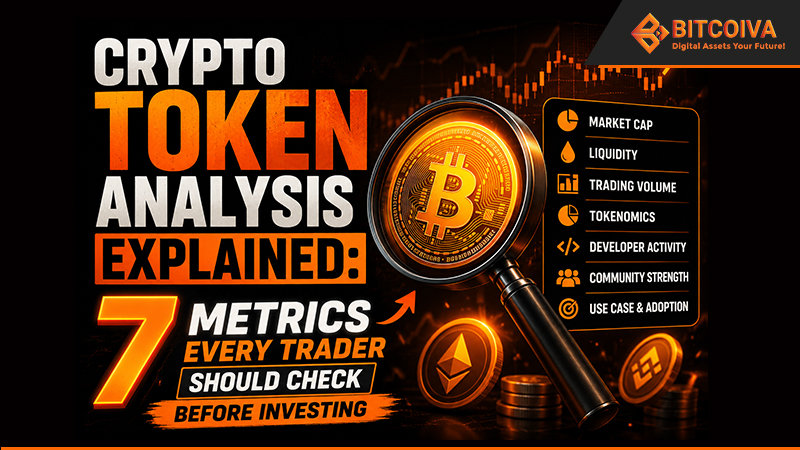
In this guide, we’ll explore the seven essential metrics every trader should check before investing in any cryptocurrency.
1. Market Capitalisation (Market Cap)
Market Capitalisation, commonly known as Market Cap, measures the total value of all tokens currently in circulation.
Formula
Market Cap = Current Token Price × Circulating Supply
Unlike token price, Market Cap provides a clearer understanding of a project’s overall size. A token priced at £0.50 is not necessarily “cheaper” than one priced at £100 because circulating supply significantly affects valuation.
Generally, cryptocurrencies can be grouped into three categories:
- Large-Cap Projects: Established cryptocurrencies with higher liquidity and relatively lower volatility.
- Mid-Cap Projects: Growing projects that offer a balance between growth potential and investment risk.
- Small-Cap Projects: Early-stage cryptocurrencies with higher growth potential but significantly greater volatility.
Market Cap should always be analysed alongside other indicators rather than used as a standalone investment metric.
2. Fully Diluted Valuation (FDV)
Fully Diluted Valuation (FDV) estimates the total value of a cryptocurrency if its maximum token supply were already in circulation.
Formula
FDV = Current Token Price × Maximum Supply
Many projects launch with only a portion of their total supply available for trading. The remaining tokens may be allocated to founders, early investors, ecosystem development, or staking rewards.
If a project has a relatively low Market Cap but an extremely high FDV, it may indicate that a significant number of tokens will enter circulation in the future. This increase in supply can place downward pressure on price if market demand does not grow at the same pace.
Comparing Market Cap and FDV helps investors understand potential future dilution and evaluate whether the current valuation is sustainable.
3. Tokenomics and Supply
Tokenomics refers to the economic design of a cryptocurrency. It explains how tokens are created, distributed, managed, and used within a blockchain ecosystem.
When researching a project, review the following:
- Circulating Supply
- Total Supply
- Maximum Supply
- Team Allocation
- Investor Allocation
- Community Rewards
- Token Burn Mechanisms
- Inflation or Deflation Model
Strong tokenomics create a healthy balance between supply and demand while encouraging long-term ecosystem growth. Transparent token allocation and sustainable emission schedules often indicate a well-planned project.
Projects with excessive team ownership, unclear distribution, or unlimited token issuance may carry higher long-term risks.
4. Trading Volume and Liquidity
Trading Volume measures how much of a cryptocurrency has been bought and sold over a given period, usually 24 hours.
Higher trading volume generally indicates:
- Strong market participation
- Better price discovery
- Greater investor confidence
- Increased buying and selling activity
Liquidity measures how easily a cryptocurrency can be bought or sold without causing significant price fluctuations.
High liquidity provides several advantages:
- Faster trade execution
- Lower slippage
- Narrow bid-ask spreads
- Better price stability
A cryptocurrency with strong trading volume and healthy liquidity is generally considered more reliable than one with low market activity.
5. Token Unlocks and Vesting Schedule
Many cryptocurrency projects do not release their entire token supply immediately. Instead, tokens are distributed gradually through a vesting schedule to founders, developers, advisors, early investors, and ecosystem funds.
These scheduled releases are known as token unlocks.
Every unlock increases the circulating supply. If a large number of tokens become available within a short period, selling pressure may increase, especially if early investors decide to realise profits.
Before investing, review:
- Upcoming token unlock dates
- Percentage of locked tokens
- Team allocations
- Investor allocations
- Vesting duration
Projects with transparent and gradual vesting schedules are generally healthier than projects with large, sudden token releases.
6. Holder Distribution and On-Chain Activity
One of blockchain technology’s greatest strengths is transparency. Every transaction is publicly recorded, allowing investors to analyse how a cryptocurrency is actually being used.
Begin by examining holder distribution.
Ask questions such as:
- How many wallet addresses own the token?
- Do a few wallets control most of the supply?
- Are exchange wallets holding a significant percentage?
- Is the number of holders increasing over time?
If only a handful of wallets own most of the supply, the project may be more vulnerable to market manipulation.
Next, analyse on-chain activity using metrics such as:
- Daily Active Addresses
- Transaction Count
- Wallet Growth
- Transfer Volume
- Exchange Inflows and Outflows
Consistent network activity often reflects healthy adoption and long-term ecosystem growth.
7. Utility and Project Fundamentals
Strong tokenomics alone cannot guarantee long-term success. A cryptocurrency should provide genuine value within its ecosystem.
Before investing, consider these questions:
- What problem does the project solve?
- Does the token have a real use case?
- Is the development team active?
- Is the roadmap realistic?
- Are strategic partnerships credible?
- Is the community growing consistently?
Projects with active development, transparent communication, and practical utility generally have stronger long-term potential than projects driven purely by speculation
Common Red Flags to Watch
Even promising projects require careful evaluation.
Be cautious if you notice:
- Extremely high FDV compared with Market Cap
- Very low liquidity
- Large upcoming token unlocks
- Concentrated whale ownership
- Unverified smart contracts
- Anonymous or inactive development teams
- Unrealistic marketing promises
- No clear real-world utility
Recognising these warning signs can help investors avoid unnecessary risk.
Final Thoughts
Successful cryptocurrency investing is not about chasing the latest trend or reacting to short-term market movements. It is about making informed decisions based on reliable data and thorough research.
By evaluating Market Capitalisation, Fully Diluted Valuation (FDV), Tokenomics, Trading Volume, Liquidity, Token Unlocks, Holder Distribution, and Project Fundamentals, investors gain a comprehensive understanding of a cryptocurrency’s strengths and weaknesses before investing.
No single metric guarantees success. However, combining these seven indicators provides a structured framework for identifying quality projects, managing risk, and building long-term confidence in your investment decisions. In an ever-evolving crypto market, disciplined research remains one of the most valuable skills every trader can develop.
Visit: www.bitcoiva.com
Frequently Asked Questions (FAQs)
1. What is crypto token analysis?
Crypto token analysis is the process of evaluating a cryptocurrency using financial, blockchain, and market data such as Market Cap, FDV, tokenomics, liquidity, trading volume, and on-chain activity to assess its investment potential.
2. Why is Market Cap more important than token price?
Market Cap reflects the overall value of a cryptocurrency by combining its current price with its circulating supply, making it a more meaningful indicator than price alone.
3. What does FDV mean in cryptocurrency?
Fully Diluted Valuation (FDV) estimates the total value of a cryptocurrency if its maximum token supply were already in circulation. It helps investors understand potential future dilution.
4. Why is liquidity important?
High liquidity allows traders to buy and sell cryptocurrencies efficiently with lower slippage, tighter bid-ask spreads, and greater price stability.
5. What are token unlocks?
Token unlocks are scheduled releases of previously locked tokens to founders, investors, advisors, or ecosystem participants. Large unlock events may increase circulating supply and influence market prices.
6. How does on-chain analysis help investors?
On-chain analysis provides transparent blockchain data, including wallet activity, transaction volume, holder distribution, and network usage, helping investors evaluate the health and adoption of a cryptocurrency.
7. Can one metric determine whether a crypto project is good?
No. Professional investors analyse multiple factors, including Market Cap, FDV, tokenomics, liquidity, on-chain activity, and project fundamentals before making investment decisions.
8. Should beginners analyse every token before investing?
Yes. Performing basic token analysis before investing helps identify potential risks, understand project fundamentals, and make more informed investment decisions.