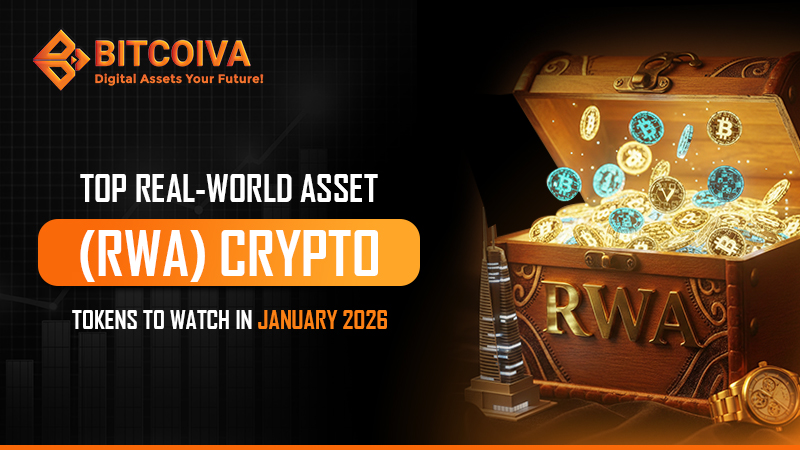
Real-World Asset (RWA) tokens are transforming the crypto ecosystem by linking physical and traditional financial assets, such as real estate, gold, bonds, and commodities, to blockchain technology. Through tokenization, RWAs improve liquidity, transparency, fractional ownership, and global investor access.
As institutional adoption accelerates, several RWA-focused crypto projects stand out for their real-world utility, strong partnerships, and long-term growth potential. Below are the top RWA crypto tokens to watch in January 2026.
What Are RWA Tokens in Crypto?
RWA tokens are blockchain-based digital assets that represent ownership or exposure to real-world assets like real estate, government bonds, commodities, invoices, and credit instruments. Tokenization converts physical or traditional financial assets into digital tokens that can be traded, tracked, and managed on-chain.
This innovation enables fractional ownership, faster settlement, global accessibility, and improved transparency compared to traditional finance systems.
Key Features of RWA Tokens
- Asset-Backed: Each token is linked to a real-world asset
- Fractional Ownership: Invest in small portions of high-value assets
- Tokenization: Physical or financial assets are converted into blockchain tokens
- Higher Liquidity: Easier trading compared to traditional markets
- Transparency: On-chain records ensure traceability
- Security: Tamper-resistant blockchain ownership records
- Global Access: Investors can participate worldwide, subject to regulations
Top RWA Crypto Tokens to Watch in 2026
1. Chainlink (LINK)
Chainlink is not a direct RWA issuer, but it is critical infrastructure for the RWA ecosystem.
Why it matters:
- Provides decentralized oracles connecting blockchains with real-world data
- Enables accurate pricing, proof-of-reserves, and asset verification
- CCIP supports secure cross-chain data and asset movement
What to watch in 2026:
- Rising oracle demand from tokenized asset platforms
- Institutional adoption of Chainlink-based RWA solutions
2. Ondo Finance (ONDO)
Ondo Finance focuses on bringing institutional-grade financial products—especially tokenized U.S. Treasury-backed instruments, on-chain.
Why it matters:
- Bridges traditional finance and DeFi
- Offers transparent, yield-generating tokenized assets
What to watch in 2026:
- Expansion beyond treasury-backed products
- Increased institutional participation
3. XDC Network (XDC)
XDC Network is a hybrid blockchain built for enterprise adoption, trade finance, and compliant RWA tokenization.
Why it matters:
- Supports cross-border trade and supply-chain finance
- Designed for regulatory-compliant asset issuance
What to watch in 2026:
- Growth in trade finance tokenization
- Strong partnerships with global enterprises
4. Quant (QNT)
Quant enables interoperability between blockchains through its Overledger technology.
Why it matters:
- RWA platforms require seamless multi-chain connectivity
- Enables asset movement and data exchange across ecosystems
What to watch in 2026:
- Increased demand for cross-chain RWA infrastructure
- Integration with DeFi and institutional platforms
5. Centrifuge (CFG)
Centrifuge tokenizes real-world assets into asset-backed NFTs used as collateral in DeFi lending.
Why it matters:
- Connects traditional assets to on-chain liquidity pools
- Enables real-world yield in DeFi markets
What to watch in 2026:
- Growth in institutional asset onboarding
- Expansion of RWA-backed lending markets
6. Goldfinch (GFI)
Goldfinch provides on-chain, under-collateralized credit backed by real-world businesses.
Why it matters:
- Brings real-world credit markets on-chain
- Expands RWAs beyond bonds and real estate
What to watch in 2026:
- Increased real-world loan issuance
- Institutional participation in credit markets
7. Maple Finance (MPL)
Maple Finance enables institutional borrowers to access on-chain liquidity through managed lending pools.
Why it matters:
- Focuses on institutional-grade borrowers
- Bridges traditional lending with DeFi efficiency
What to watch in 2026:
- Growth in tokenized debt markets
- Partnerships with traditional finance firms
8. Maker (MKR)
MKR is the governance token of MakerDAO, which manages the DAI stablecoin backed increasingly by real-world assets.
Why it matters:
- Integrates real-world collateral like treasuries into DeFi
- Enhances stability and trust in DAI
What to watch in 2026:
- Expansion of RWA collateral types
- Governance-driven RWA innovation
9. Polymesh (POLYX)
Polymesh is a blockchain purpose-built for regulated financial assets and security tokens.
Why it matters:
- Compliance-first architecture
- Preferred by institutional issuers
What to watch in 2026:
- Growth in regulated tokenized securities
- Adoption by financial institutions
Emerging RWA Trends in 2026
- Sector Expansion: Commodities, IP, carbon credits, and art
- ESG Integration: Tokenized green and sustainable assets
- Institutional Adoption: Banks and asset managers entering RWA markets
- Advanced Tokenomics: Utility-focused token designs
- Secondary Markets: Improved liquidity and price discovery
Types of Real-World Assets Being Tokenized
- Real Estate: Fractional property ownership
- Commodities: Gold, silver, oil, and metals
- Securities: Tokenized stocks and bonds
- Credit & Invoices: Trade finance and lending assets
- Art & Collectibles: Fractional ownership of high-value items
- Intellectual Property: Patents, copyrights, and royalties
Challenges of RWA Tokenization
- Regulatory Uncertainty: Varying global regulations
- Valuation Complexity: Accurate pricing challenges
- Liquidity Risks: Lower trading volumes for some assets
- Security Risks: Smart contract vulnerabilities
- Custody & Ownership: Legal clarity and asset protection
Conclusion
Real-world asset tokenization is reshaping global finance by bridging traditional assets with blockchain technology. As adoption grows, RWA tokens are expected to play a critical role in institutional DeFi, offering improved transparency, liquidity, and global investment access in 2026 and beyond.
Visit us at: www.bitcoiva.com
FAQ
Q1: What are RWA tokens in crypto?
A1: RWA tokens represent real-world assets like real estate, bonds, or commodities on the blockchain.
Q2: Why are RWA tokens important in 2026?
A2: They bridge traditional finance with blockchain, offering liquidity, transparency, and institutional access.
Q3: Which RWA crypto is infrastructure-focused?
A3: Chainlink (LINK) provides oracle and interoperability services essential for RWA platforms.
Q4: Are RWA tokens safer than normal crypto?
A4: They are often backed by real assets, which may reduce volatility but still carry risk.
Q5: Can institutions invest in RWA tokens?
A5: Yes, many RWA platforms are built with regulatory compliance for institutional adoption.
Q6: Which token specializes in tokenized treasuries?
A6: Ondo Finance (ONDO) focuses on tokenized U.S. Treasury-backed financial instruments.
Q7: What RWA platform uses NFTs as collateral?
A7: Centrifuge (CFG) tokenizes real-world assets into NFTs for use in DeFi lending pools.
Q8: Which token manages a stablecoin backed by RWAs?
A8: Maker (MKR) uses real-world collateral, including treasuries, to support the DAI stablecoin.
Q9: What RWA blockchain supports regulated financial assets?
A9: Polymesh (POLYX) is designed for compliance and issuance of tokenized securities.
Q10: What types of assets can RWAs cover?
A10: RWAs can include real estate, bonds, treasuries, commodities, invoices, credit, securities, art, and intellectual property.