
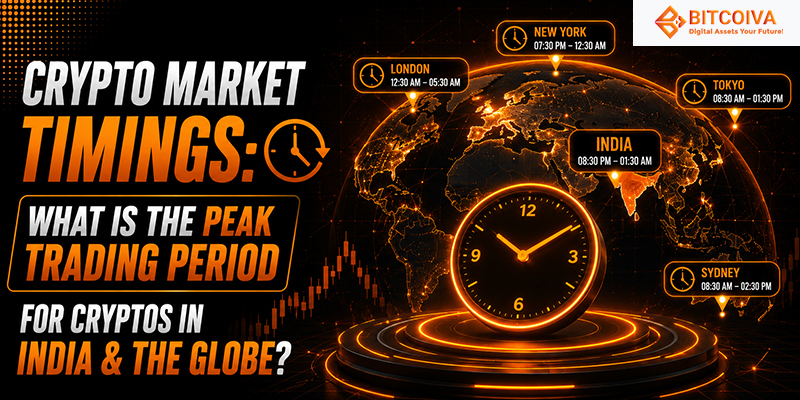
Ask ten crypto traders when the market opens, and most of them will laugh.
There is no opening bell. No 3:30 PM shutdown like the NSE. No traditional holiday closure.
Crypto markets operate 24 hours a day, 7 days a week.
But there is an important difference between being open and being active.
Crypto trading activity, volatility, and liquidity change throughout the day. Some hours attract significantly more participation than others. For traders, understanding these patterns can help with trade execution, spread management, and risk control.
So, what is the best time to trade crypto in India?
There is no universal “best” hour for every trader or every cryptocurrency. However, global research shows that crypto market activity tends to become stronger during periods when major financial markets are active, with a particularly notable global peak around 16:00–17:00 UTC in one large-scale study.
For Indian traders, that corresponds to approximately 9:30 PM–10:30 PM IST.
Why Crypto Trading Timings Matter
Because crypto markets never close, beginners often assume that market conditions remain the same throughout the day.
They don’t.
Trading activity can vary depending on:
- Global market participation
- European and U.S. market activity
- Major economic announcements
- Cryptocurrency-specific news
- Liquidity and order-book depth
- Day of the week
- The particular cryptocurrency or trading pair
This means the time you trade can affect the spread, liquidity, volatility, and execution quality you experience.
For example, a market order placed during a highly liquid period may receive better execution than the same order placed during a quieter period.
How 24/7 Crypto Markets Actually Work
Unlike traditional stock markets, cryptocurrency markets operate across a global network of centralized and decentralized venues rather than following one universal exchange timetable.
There is no single global “crypto opening time.”
Instead, different exchanges and market participants operate continuously across time zones.
However, market activity is not evenly distributed across all 24 hours.
Research published in the Review of Quantitative Finance and Accounting examined 1,940 cryptocurrency trading pairs across 38 centralized exchanges and found clear intraday patterns in trading activity, volatility, and illiquidity. The study found that these measures generally increased later in the day and peaked around 16:00–17:00 UTC.
This provides strong evidence that even a 24/7 market can have identifiable periods of higher activity.
Major Global Market Sessions
Crypto does not officially have Asian, European, or U.S. “sessions” in the same way that traditional markets do.
However, traders commonly use these labels to describe periods when participants from those regions are most active.
Asian Market Hours
Asian trading activity generally becomes more prominent during the Asian business day.
For Indian traders, this broadly covers the morning and early afternoon IST.
Activity during this period can be important for understanding overnight price movements and Asian market sentiment.
However, it should not automatically be considered a low-volatility or low-volume session. Conditions vary significantly by cryptocurrency and market news.
European Market Hours
European participation increases from the Indian afternoon into the evening.
As European traders and institutions become more active, crypto market activity can increase.
This period can become particularly important when European economic data or cryptocurrency-specific developments are released.
U.S. Market Hours
U.S. market participation becomes increasingly important during the Indian evening and night.
Major U.S. economic events—including Federal Reserve decisions, inflation data, employment reports, and other macroeconomic releases—can create significant volatility in cryptocurrency markets.
Because U.S. and European market participation can overlap, this period is often closely watched by crypto traders.
Important: U.S. and European market times can shift by an hour in IST because of daylight-saving-time changes. Therefore, fixed session times should be treated as approximate rather than permanent.
What Is the Peak Crypto Trading Period for Indian Traders?
There is no guaranteed “best time” to trade crypto.
However, research provides a useful benchmark.
A large academic study found that trading activity, volatility, and illiquidity in its sample peaked between 16:00 and 17:00 UTC.
For India, that is approximately:
9:30 PM–10:30 PM IST
This period can therefore be considered an important high-activity window for Indian traders.
The broader evening period can also be worth monitoring because European and U.S. participation is active around this time.
However, the exact peak can vary depending on:
- The cryptocurrency
- The exchange
- Market conditions
- Economic announcements
- Daylight-saving changes
- Major market events
So, instead of treating 9:30–10:30 PM as a guaranteed “best trading time,” use it as a reference window for potentially higher market activity.
Does the Day of the Week Matter?
Yes, trading activity can also vary by day.
Many market analyses have observed stronger activity during the middle of the traditional business week, but there is no universal rule saying that Tuesday, Wednesday, or Thursday will always be the best trading days.
Crypto markets can react to scheduled events such as:
- U.S. inflation data
- Federal Reserve decisions
- Employment reports
- ETF-related developments
- Major cryptocurrency announcements
- Regulatory developments
Therefore, the economic calendar can sometimes matter more than the day itself.
For example, a major economic announcement can create substantial volatility regardless of whether it occurs on Monday or Friday.
What About Crypto Trading on Weekends?
Crypto markets remain open on Saturday and Sunday.
However, weekend market conditions can differ from weekdays.
Traditional financial institutions and many professional market participants operate on different schedules over the weekend. As a result, liquidity and market depth can change.
This can sometimes produce:
- Wider spreads
- Lower order-book depth
- Larger price reactions to individual orders
- Sudden volatility
- Less predictable price movements
That does not mean traders should automatically avoid weekends.
Instead, traders should monitor liquidity and spreads before entering a position.
Which Trading Strategy Depends Most on Timing?
Different traders care about market timing in different ways.
Scalpers
Scalpers generally need strong liquidity and efficient execution because they target relatively small price movements.
For them, trading during active periods can be particularly important.
Day Traders
Day traders may pay close attention to periods when global participation increases.
The Indian evening can be particularly relevant because European and U.S. market activity becomes more prominent.
Swing Traders
Swing traders usually care less about the exact hour of entry.
Instead, they may focus more on:
- Market structure
- Trend direction
- Volume
- Support and resistance
- News events
- Risk/reward
Long-Term Investors
For investors accumulating cryptocurrency over months or years, the exact hour of purchase is generally much less important than factors such as asset allocation, risk management, and investment strategy.
How Liquidity Affects Crypto Trading
Liquidity is one of the most important reasons trading time matters.
Liquidity describes how easily an asset can be bought or sold without significantly affecting its price.
When liquidity is strong:
- Buy and sell orders are generally easier to match
- Spreads may be tighter
- Larger orders can potentially be executed with less price impact
When liquidity is weaker:
- Spreads may become wider
- Order-book depth can decrease
- Larger orders can have greater price impact
- Slippage can become more significant
The academic research mentioned earlier found that crypto market activity and illiquidity follow clear intraday patterns, reinforcing the idea that market conditions can change substantially depending on the hour.
Best Practices for Trading Around High-Activity Periods
1. Check the spread
Before placing an order, look at the bid-ask spread.
A wider-than-usual spread can indicate weaker liquidity.
2. Check the order book
Order-book depth can help you understand how much buying and selling interest is available near the current price.
3. Be careful with market orders
Market orders prioritize execution rather than a specific price.
During volatile or less-liquid periods, this can increase the possibility of unexpected execution prices.
4. Consider limit orders
Limit orders allow you to specify the maximum price you are willing to pay or the minimum price you are willing to accept.
They can provide greater price control, although there is no guarantee that the order will be filled.
5. Follow the economic calendar
Major U.S. economic events can create sudden cryptocurrency price movements.
Pay particular attention to:
- Federal Reserve decisions
- Inflation data
- Employment reports
- GDP releases
- Major regulatory announcements
6. Don’t assume every price spike is a trend
A sudden move during a low-liquidity period can reverse quickly.
Always consider volume, market structure, liquidity, and broader market conditions before interpreting a move.
7. Track your own trading results
The best trading period for one trader may not be the best for another.
Record your:
- Entry time
- Exit time
- Trading pair
- Strategy
- Profit/loss
- Spread
- Market conditions
After several weeks or months, your own trading history can reveal which periods actually work best for your strategy.
What Metrics Should Crypto Traders Track?
Trading time is only one part of market analysis.
Consider monitoring these metrics alongside the clock:
24-Hour Trading Volume
Volume shows how much trading activity has taken place over a rolling 24-hour period.
Increasing volume can provide additional context for a price movement.
Bid-Ask Spread
The spread is the difference between the highest available bid and the lowest available ask.
A larger spread can indicate weaker liquidity.
Order-Book Depth
Order-book depth shows the amount of buy and sell interest around the current market price.
Open Interest
For futures traders, open interest shows the number of outstanding derivative contracts.
Funding Rate
Funding rates can provide additional information about positioning in perpetual futures markets.
BTC Dominance
Bitcoin dominance measures Bitcoin’s share of the total cryptocurrency market capitalization and is often monitored when assessing broader market rotation.
Economic Calendar
Macroeconomic events can have a significant impact on crypto volatility, particularly when they affect interest-rate expectations or overall risk sentiment.
Does the “Best Time” Change for Different Cryptocurrencies?
Yes.
Bitcoin, Ethereum, altcoins, stablecoin pairs, and smaller-cap assets can have different liquidity profiles.
A highly liquid BTC/USDT market may behave differently from a smaller altcoin pair.
Therefore, traders should avoid assuming that one time window applies equally to every cryptocurrency.
The academic study also found that intraday patterns were broadly similar across many trading pairs, but characteristics of the individual trading pairs and exchanges still explained some differences.
What About Crypto Taxes in India?
Trading time does not determine the applicable tax rate.
Under India’s current tax framework, income from the transfer of Virtual Digital Assets (VDAs) is subject to a 30% tax, along with applicable surcharge and cess, under the provisions referenced by the Income Tax Department.
The Income Tax Department also provides a transaction-wise Schedule VDA for reporting VDA income.
There have also been changes to tax forms and reporting procedures from 1 April 2026 under India’s new tax framework. The Income Tax Department states that VDA-related TDS transactions occurring on or after 1 April 2026 are handled through the new tax-law reporting mechanism.
Because crypto taxation can depend on the transaction, taxpayer status, and applicable rules, traders should refer to the latest Income Tax Department guidance or consult a qualified tax professional rather than relying only on a general trading article.
How to Put Crypto Market Timing Into Practice
You don’t need to watch the crypto market 24 hours a day.
Instead:
Step 1: Identify your trading style.
Are you a scalper, day trader, swing trader, or long-term investor?
Step 2: Identify high-activity periods.
For Indian traders, the evening period deserves attention, with research identifying 16:00–17:00 UTC (approximately 9:30–10:30 PM IST) as a notable peak in activity in its historical sample.
Step 3: Check the economic calendar.
Know when major U.S. and global economic announcements are scheduled.
Step 4: Check liquidity before trading.
Look at spreads, order-book depth, and recent volume.
Step 5: Use alerts.
Price and volume alerts can help you avoid constantly watching charts.
Step 6: Review your trading data.
After enough trades, compare your results by time of day and day of week.
Your own data should ultimately guide your trading schedule.
Where Is Crypto Market Timing Headed?
Crypto markets continue to evolve as institutional participation, algorithmic trading, derivatives, ETFs, and professional market infrastructure develop.
As participation increases, market liquidity patterns may change.
Algorithmic trading can also operate around the clock, potentially reducing some differences between active and quiet periods.
However, major news events can still produce sudden volatility at almost any hour.
This is why traders should treat historical timing patterns as guidance, not guarantees.
The Bottom Line
Crypto markets never close.
But that doesn’t mean every hour offers the same trading conditions.
Research shows clear intraday patterns in crypto trading activity, volatility, and illiquidity, with one large study of 1,940 trading pairs across 38 exchanges finding a peak between 16:00 and 17:00 UTC.
For Indian traders, that translates to approximately 9:30 PM–10:30 PM IST.
However, there is no universal best time to trade.
The right trading window depends on your:
- Strategy
- Cryptocurrency
- Exchange
- Risk tolerance
- Liquidity conditions
- Market news
- Trading objectives
Instead of asking only “What is the best time to trade crypto?”, ask:
“When does my chosen market have the liquidity and conditions that suit my strategy?”
That is a much more useful question.
Visit: www.bitcoiva.com
Frequently Asked Questions
Does the crypto market ever close?
No. Major cryptocurrency markets operate continuously, 24 hours a day and 7 days a week. However, individual exchanges can have their own maintenance periods or temporary outages.
What is the best time to trade crypto in India?
There is no guaranteed best time. However, research has identified 16:00–17:00 UTC, approximately 9:30–10:30 PM IST, as a notable peak in trading activity, volatility, and illiquidity in a large historical sample.
Why is the evening important for Indian crypto traders?
The Indian evening overlaps with periods of significant European and U.S. market participation. Major U.S. economic events can also occur during this broad period and influence crypto markets.
Is 9:30–10:30 PM IST always the best time?
No.
It is better understood as a historically observed high-activity window, not a guaranteed profitable trading period.
Is crypto trading active on weekends?
Yes. Crypto markets continue operating on weekends, but liquidity and participation can differ from weekdays.
Should I avoid trading crypto on weekends?
Not necessarily.
Instead, check the spread, order-book depth, volume, and current market conditions before trading.
Does trading time matter for long-term investors?
Usually much less.
For long-term investors, factors such as investment horizon, asset allocation, risk management, and overall strategy generally matter more than the exact hour of purchase.
Why can crypto prices move suddenly at night?
Lower liquidity can sometimes make markets more sensitive to individual orders. However, major news can also cause large price movements at any hour.
Does trading time affect crypto tax in India?
No. The time of day does not determine the applicable VDA tax treatment. The Income Tax Department states that income from VDA transfers is subject to a 30% tax along with applicable surcharge and cess under the relevant provisions.
What should I check before trading?
At minimum, consider:
- Trading volume
- Bid-ask spread
- Order-book depth
- Price volatility
- Open interest and funding rates for derivatives
- Major economic announcements
- Your own risk-management rules
What tools can I use to monitor crypto markets?
Trading platforms and charting/data services can provide information such as price, volume, order-book data, and market statistics. The important thing is to combine these metrics rather than relying on trading time alone.
Final Takeaway
Crypto trades 24/7, but market activity isn’t equal 24/7.
For Indian traders, the evening can be an important period to monitor, with academic research identifying 9:30–10:30 PM IST as the approximate conversion of a historically observed global activity peak.
But timing is only one piece of the puzzle.
Liquidity + Volume + Volatility + Market News + Risk Management = Better Trading Decisions.